A sweet new way to make some noise

Marshmallow
Clapsticks

Play it. Share it. Make a beat.

A pair of percussion sticks made entirely from marshmallows.

Meet the clapsticks ↘
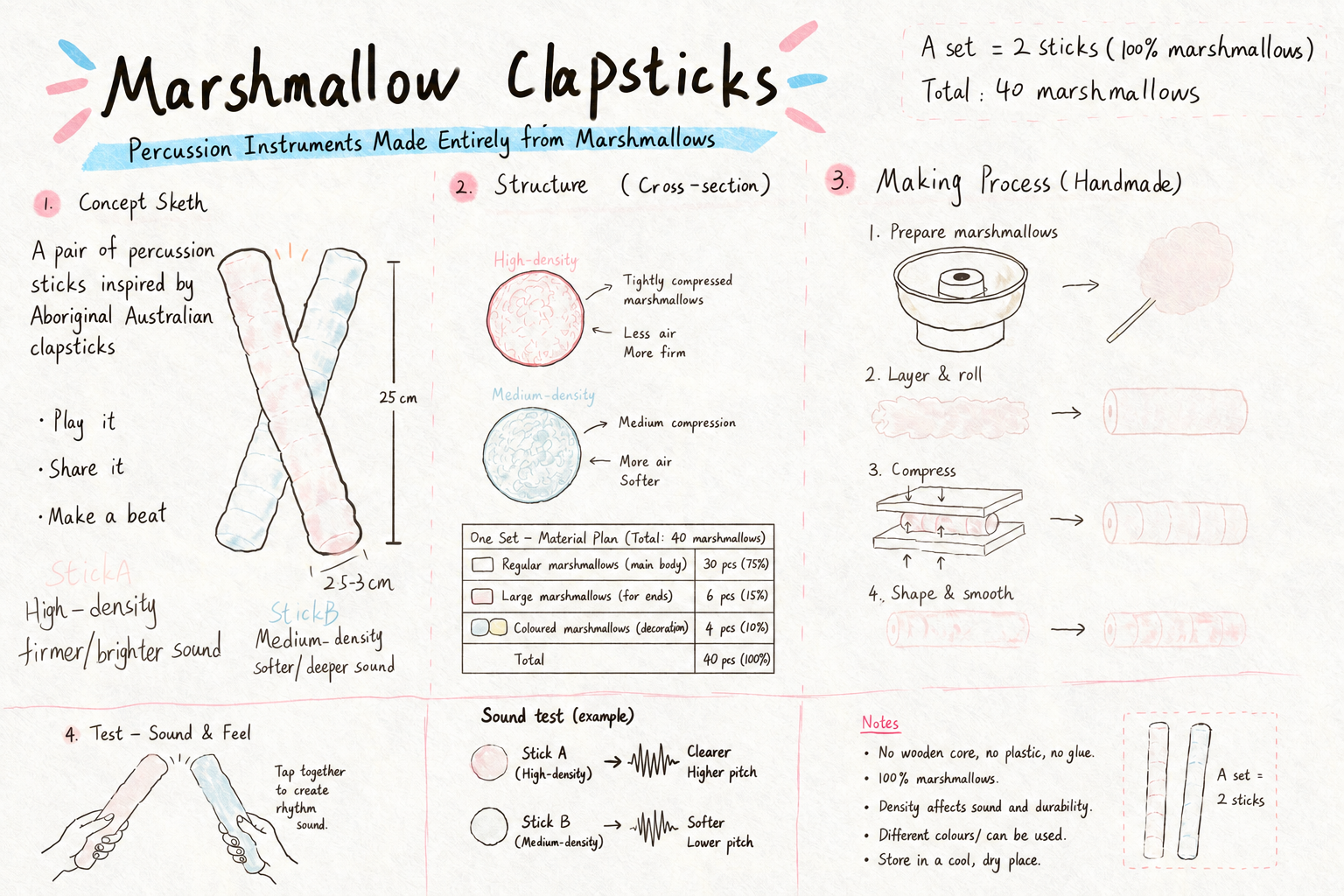
Hand-drawn Marshmallow Clapsticks product concept
our first sketch!
PLAY IT ✦ SHARE IT ✦ MAKE MUSIC ✦ MAKE A BEAT ✦ PLAY IT ✦ SHARE IT ✦ MAKE MUSIC ✦

01 / EXPLORE

Product

Meet the clapsticks, explore the design and discover who they are for.

PRODUCT / OVERVIEW & FEATURES

Soft, surprising
and made to play.

Marshmallow Clapsticks turn a familiar rhythm activity into a playful rhythm experience. Tap the sticks, explore the sound and share the moment.

100%marshmallows
2sticks in one set
≈ 25 cmlong per stick
2 soundsfrom different densities

PRODUCT / HOW IT WORKS

One pair.
Two different sounds.

The pink stick is compressed more tightly. The blue stick keeps more air inside. Different densities create different sounds.

STICK A · HIGH DENSITY

Firm & brighter

╱╲╱╲╱╲
Less air • tighter compression • clearer, higher sound

STICK B · MEDIUM DENSITY

Soft & deeper

∿ ∿ ∿
More air • medium compression • softer, lower sound

Handmade in four simple steps

01

Make

Prepare the soft marshmallow texture.

02

Layer & roll

Build even layers and roll a long cylinder.

03

Compress

Use different pressure for different densities.

04

Shape & test

Smooth, tap and compare the sound.

PRODUCT / THREE EXPERIENCES

Three parts of
the experience.

Our product can create a short emotional response, support a positive mood and produce visible signs of enjoyment.

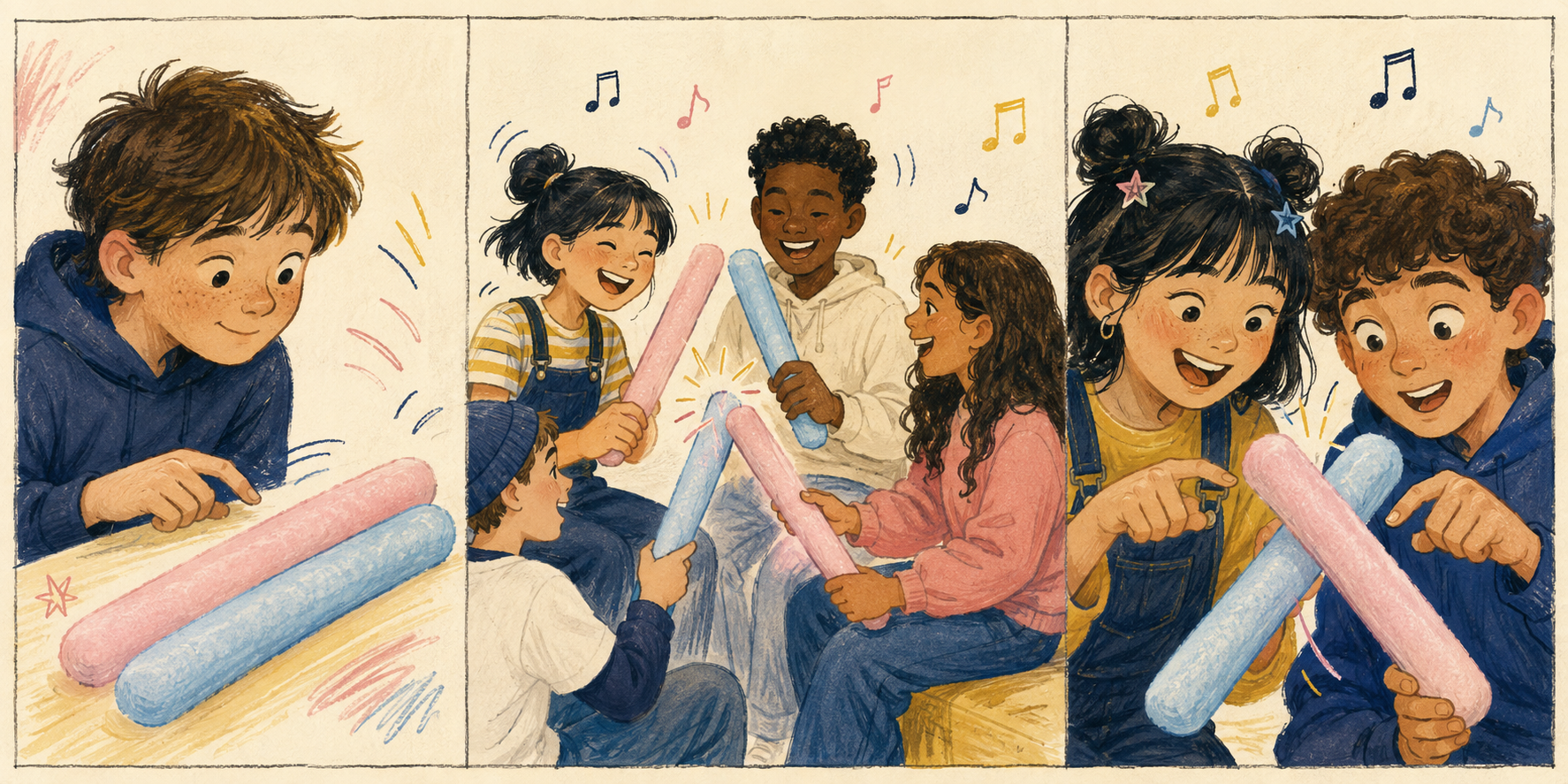
A young person showing interest in pink and blue Marshmallow Clapsticks

EMOTION · SHORT RESPONSE

Interest

Emotion is a feeling caused by a specific event.

The unusual idea of a marshmallow instrument makes people want to look closer, touch it and discover how it works.

A group excitedly playing Marshmallow Clapsticks together

MOOD · LASTING FEELING

Excited

Mood lasts longer and is less connected to one clear trigger.

Making rhythms together creates an energetic, playful and positive mood for the whole group.

Young people visibly expressing curiosity while testing Marshmallow Clapsticks

AFFECT · VISIBLE EXPRESSION

Curiosity

Affect is how feelings are shown through the face, voice and body.

Bright eyes, smiles and trying different tapping movements show curiosity and enjoyment.

PRODUCT / WHO IT’S FOR

Made for shared
moments.

ABC

Schools

Creative music and learning activities.

◎

Cultural organisations

A starting point for respectful discussion and creativity.

✦

Community events

Friendly, hands-on group experiences.

☺

Families & young people

Simple play to enjoy together.

02 / EXPLORE

Our Story & Team

The idea, the people and the motivation behind our project.

OUR STORY & TEAM / OUR IDEA

Music, marshmallows and one curious idea.

Our idea began with a simple question: what if we made a rhythm instrument entirely from marshmallows?

We combined a two-stick rhythm interaction with a completely different material—marshmallows—to create an experience that connects sound, creativity and an unexpected material.

Traditional wooden clapsticks being played
A cultural starting pointClapsticks showed us how two simple objects can create rhythm. We recognise their importance to Aboriginal and Torres Strait Islander cultures and use this reference with respect.

Marshmallow Clapsticks is a student innovation concept. It does not copy or replace the cultural meaning of traditional clapsticks.

OUR STORY & TEAM / FOUR ROLES

Four people.
One playful idea.

Each role matches the way we can best support the project.

BW

Team Coordinator

Boteng Wang

Keeps our ideas, tasks and discussions connected.

ZZ

Presenter

Zheran Zhang

Explains our product clearly and brings energy.

HF

Research

Haolin Feng

Checks information and keeps our ideas practical.

AF

Team Support

Aizi Fu

Listens, helps others and supports each task.

OUR STORY & TEAM / TEAM JOURNEY

What moved us
from idea to action?

Motivation is the force that starts, guides and keeps our behaviour going. Our project is shaped by both intrinsic and extrinsic motivation.

INSIDECuriosityWe enjoy the creative task itself
+
OUTSIDERecognitionFeedback encourages us to improve
→
OUR RESULTA playful idea
turned into action
♥

FROM WITHIN

Intrinsic motivation

Our intrinsic motivation comes from the interest and satisfaction of the innovation process itself. We are curious about turning ordinary marshmallows into something that can be shaped, tapped and played.

  • Enjoying the task itself
  • Designing and testing the shape
  • Exploring music, materials and culture
★

FROM AROUND US

Extrinsic motivation

Our extrinsic motivation comes from results and recognition. We hope to receive useful feedback and show that our creativity and teamwork have practical value.

  • Class presentation feedback
  • Recognition from students and teachers
  • Encouragement to keep improving
OUR TEAM JOURNEY →

Curiosity made us want to try the idea. Designing and testing kept the work enjoyable. Feedback and recognition gave us another reason to improve it. Together, these internal and external factors moved our team from an unusual question to a product concept we could share.

03 / EXPLORE

Team Reflection

Reflecting on our teamwork through organisational behaviour.

TEAM REFLECTION / WEEK 7

Team performance and
psychological safety.

Learning to make room for different views.

The issue and its causes

In a product design discussion in the early stage of the project, the team needed to determine the number of grams of marshmallows needed to make a set of Marshmallow Clapsticks. As a Researcher, Haolin had doubts about the number used at that time, but because the team had just started to cooperate and the members were not familiar enough, he was worried that directly questioning the judgment of other members might cause embarrassment, so he did not raise it immediately at first. Later, after other members took the initiative to ask for his research opinions, he proposed the need to re-verify the amount of marshmallows, and the team also further checked and adjusted the relevant information.

Our Week 7 analysis

Psychological safety means feeling safe to ask questions, share different views and take interpersonal risks. Haolin’s hesitation illustrates how low psychological safety can limit open communication and knowledge sharing.

Social Facilitation Theory considers how the presence of others can influence individual performance. Week 7 presents social facilitation as a potential process gain. It offers a further lens for considering Haolin’s participation during group discussions. However, his greater willingness to speak after receiving encouragement mainly supports the psychological safety explanation; it does not, by itself, show that others’ presence improved his task performance.

Impact and resolution

Haolin's initial hesitation meant that the team did not immediately recheck the amount of marshmallows required for each set of Clapsticks. This delayed the revision of product information, and also reflects how the limited Psychological Safety affects knowledge sharing and team decision-making.

Later, other members took the initiative to ask Haolin's opinion. He raised questions about the amount of marshmallows, and the team then rechecked and adjusted the relevant information together. This positive response made him realize that questioning an idea is not considered a criticism of the individual, so in subsequent discussions, he became more willing to share research results and different views.

This problem has improved so far, but maintaining Psychological Safety still requires the continuous efforts of the team. From this experience, the team realized that it is necessary to actively invite members to ask questions and respond in a constructive way so that potential issues can be raised earlier, while making full use of each member's expertise.

Course concepts: MGMT2007, Week 7 — Psychological safety (slides 11–12); Social facilitation (slide 20).

TEAM REFLECTION / WEEK 9

Judgment and Decision Making

Using feedback to rethink our message and make a better decision.

The issue and its causes

When we first discussed the Marshmallow Clapsticks website, we wanted the product to create both a rhythm activity and a social experience. We thought that sharing marshmallows could encourage interaction, so we included “Edible” as a feature in the first draft.

This decision made sense to us as designers, but we did not fully consider how an external evaluator might interpret it. Dr EY Song later reminded us by email to focus on the innovation of the product itself, rather than the existing edible properties of marshmallows. The key decision then became whether to keep our original promotional message or change it in response to this feedback.

Our Week 9 analysis

Framing Bias occurs when the way an issue is presented influences people’s judgment. We initially framed edibility as a social benefit. Within that frame, it seemed worth promoting. However, an evaluator could read the same claim as an innovative selling point, even though edibility is already a property of marshmallows. Our positive designer perspective made this alternative interpretation easier to overlook.

At the individual level, we judged the feature through our own design intentions. At the team level, although all members took part, our discussion mainly stayed within the same social-value frame. Having everyone participate did not automatically mean that we considered different ways of understanding the product.

Bounded Rationality (Simon, 1972) provides another explanation. People make decisions with limited time, information and cognitive capacity, so they cannot assess every relevant factor. Our initial evaluation focused on a few familiar criteria, especially social value, without sufficiently considering innovation and audience understanding. The feedback brought an overlooked criterion into our decision: what would the website lead an outside reader to believe?

How feedback changed our decision

The original message risked blurring the product’s core innovation and created extra revision work. After receiving the email, we re-examined the promotional focus together. We recognised that our intention to encourage social interaction did not guarantee that an evaluator would understand the message in the same way.

We therefore changed the question guiding our decision. Instead of only asking how edibility could support interaction, we considered how the website could communicate the product’s innovative value more clearly. We decided to remove the promotional claims about edibility and focus on tapping together, creating rhythms and social interaction.

The change was more than a wording edit: external feedback helped us reconsider the frame behind our original judgment. We kept the goal of a shared social experience, but changed how we communicated it. This shows how feedback can improve a team decision when members use it to reassess their assumptions.

What we will do differently

We learned that a reasonable design intention can still lead to a biased promotional decision. Before agreeing on future content, we will evaluate each claim from three perspectives: social value, innovation and audience understanding. Each member will consider both what we intend to communicate and how someone outside the team might interpret it. We will compare these views and check for possible misunderstandings before publishing.

When we receive external feedback, we will use these same perspectives to reconsider the reasoning behind a claim as well as its wording. Our response to the teacher’s email improved this decision, but it does not prove that the bias has disappeared. Keeping this review process will help us question our first impressions and make better decisions together.

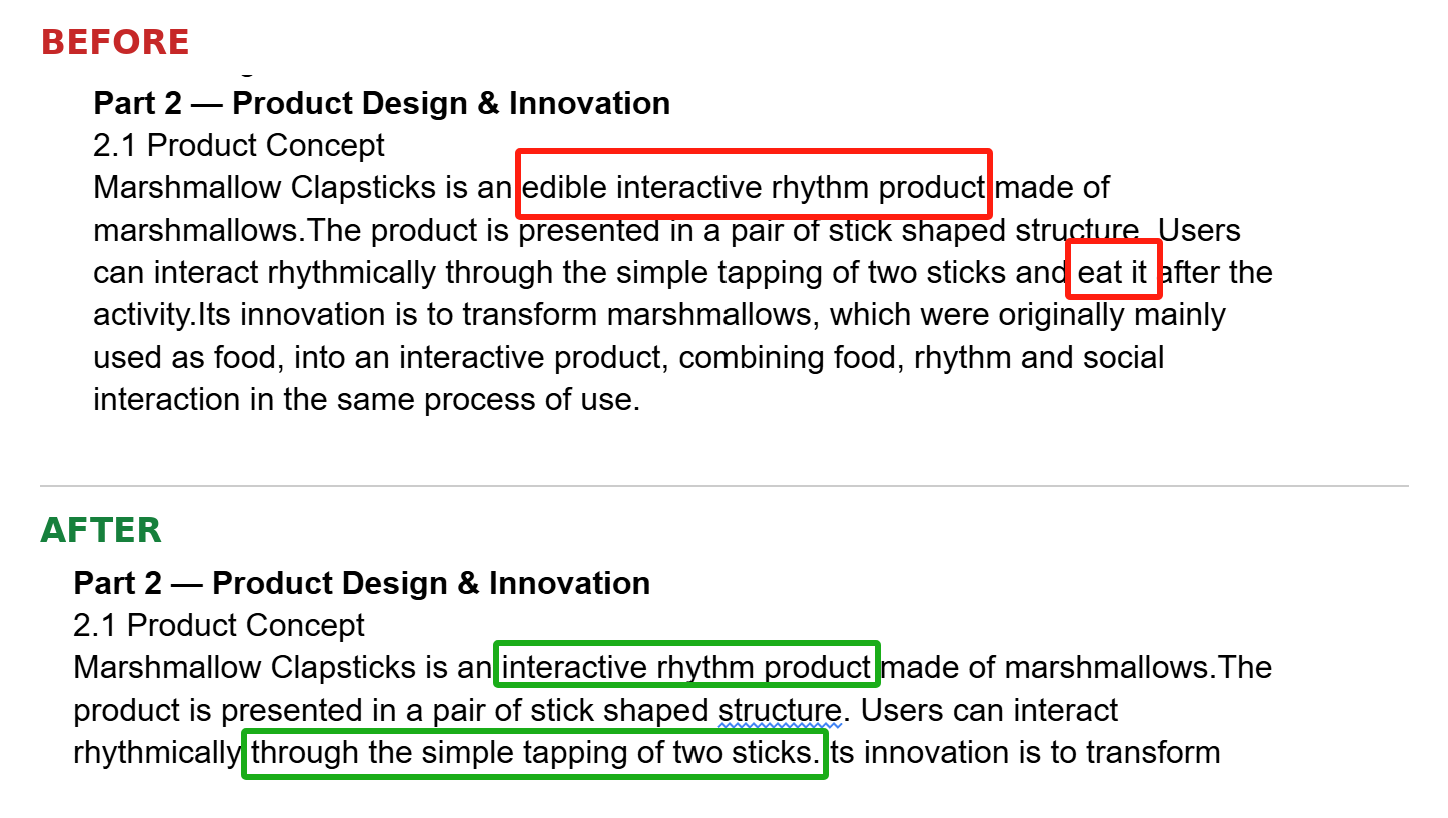
Before and after product concept comparison: the original highlights an edible interactive rhythm product and eating it after the activity; the revised wording highlights an interactive rhythm product and tapping two sticks.
BEFORE → AFTEROur product concept changed from highlighting edibility to highlighting rhythm interaction. Open the image to read the original comparison at full size.

Course concepts: MGMT2007, Week 9 — Framing Bias and Bounded Rationality. Simon (1972) is cited in the team’s original Story 2 document.
TEAM REFLECTION / OVERALL REFLECTION

What we take forward

Our Week 7 experience showed us that assigning roles is only part of effective teamwork. Members also need to feel able to use their expertise and question ideas. We want to keep inviting different views, discussing concerns respectfully and checking whether our discussions lead to better decisions.